

Letter from the Philippines
Boss or chump or both?

There’s a popular ride-share app in the Philippines called Grab. I stubbornly try to avoid Uber and Lyft in the U.S. because I refuse to accept declarations of inevitable demise of any given industry when tech companies enter the scene. I want taxi drivers to have unions, make a living wage, build worker solidarity, and all the things that Uber and Lyft deny. When people tell me “the writing is on the wall,” I like to demur. For now, I still have a choice.
For that reason, when I left Aquino Airport in Manila, I pushed my way through the thick night air to the taxi stand, where a no-nonsense middle aged woman dressed in business casual proceeded to plow a path down the crowded bumpy sidewalk. I followed, hefting a duffel bag over one arm, dragging a suitcase with the over, and trying my best not to knock people into the road. We couldn’t hear each other over the crowd and traffic. For two long minutes, we pummeled through travelers without speaking until we reached a waiting cab.
“I’m headed to Pension Natividad in Malate. Can you tell me what this ride will cost?” I asked before I got in. I have next to no Tagalog, but many Filipinos speak English.
She took a moment to calculate and then answered decisively, “3,000 pesos.”
I did my own quick calculation. She was asking for U.S. $50 for a 20 minute ride. I was on a strict budget; there was no way! I politely declined, she didn’t counter offer, and I reluctantly pulled out my phone to download Grab.
“Oh Grab, it’ll cost the same and they won’t come for an hour,” she told me. She began directing me through the crowd with the same assertiveness as before. I followed mostly because it was the only way back. We landed at a stand with a printed “Grab” sign.
“She’ll tell you,” she announced, pointing to a woman standing inside the small structure. A wave of distrust rolled through me.
At that very moment, the Grab app finished downloading, and I checked the ride. It cost $3 and would arrive in minutes. I felt vindicated. I felt miserable. Is there no middle ground between $3 and $50? How is it that if I’m not the one being swindled, I become the swindler. I felt the thud of having fully arrived in a place where my ethical considerations don’t translate and my naiveté pumps like blood under the skin.

In mid-January, I took my third annual trip to see my now 90-year-old aunt Dolores in Manila. Her husband Larry died several years ago and she has no children. Thanks to social security, she can afford a full-time live-in caregiver, a role split by sisters Clarita and Beth.
Dolores is low-key famous to me. My mom’s eldest sister, she attended college in the Philippines, leaving small-town Schenectady, New York for city life in Manila under the watchful eyes of her aunties. There, she became the first variety tv show hostess of the Philippines with her own hour-long revue called The Dee Marquez Show. The way I understand it, she almost married in the Philippines but decided to leave the variety show and her fiancé and move back to the States. I don’t know the exact circumstances, but I smell intrigue!
Not long after that, she married Bob Merrill, a wealthy lyricist known for writing hits like “(How Much is) That Doggie in the Window” and “Mambo Italiano” and the lyrics for several Barbara Streisand musicals including Funny Girl. She lived with him in the lap of luxury in Los Angeles in what had been Ava Gabor’s house. Her monthly clothing allowance was so large that it cost only one-third of it for her to buy my mom, then in community college, a VW Bug.
Her marriage to Merrill didn’t last and she’d signed a prenup so she walked away with a clean split, a baby grand piano, her clothing, and nothing else. By the time I knew her, she was living in New York City and partnered with Larry. Years later, they decided to retire to the Philippines where their modest social security payments would stretch further.
These days, Dolores almost never leaves her apartment. Her skin is silky smooth and her cheekbones stand out like ivory stones. She usually moves about her apartment in an elegant white cotton nightgown. She has no short-term memory to speak of and only selective long-term memory so that she never remembers who I am, although she masks this confusion with a charming debonair front.
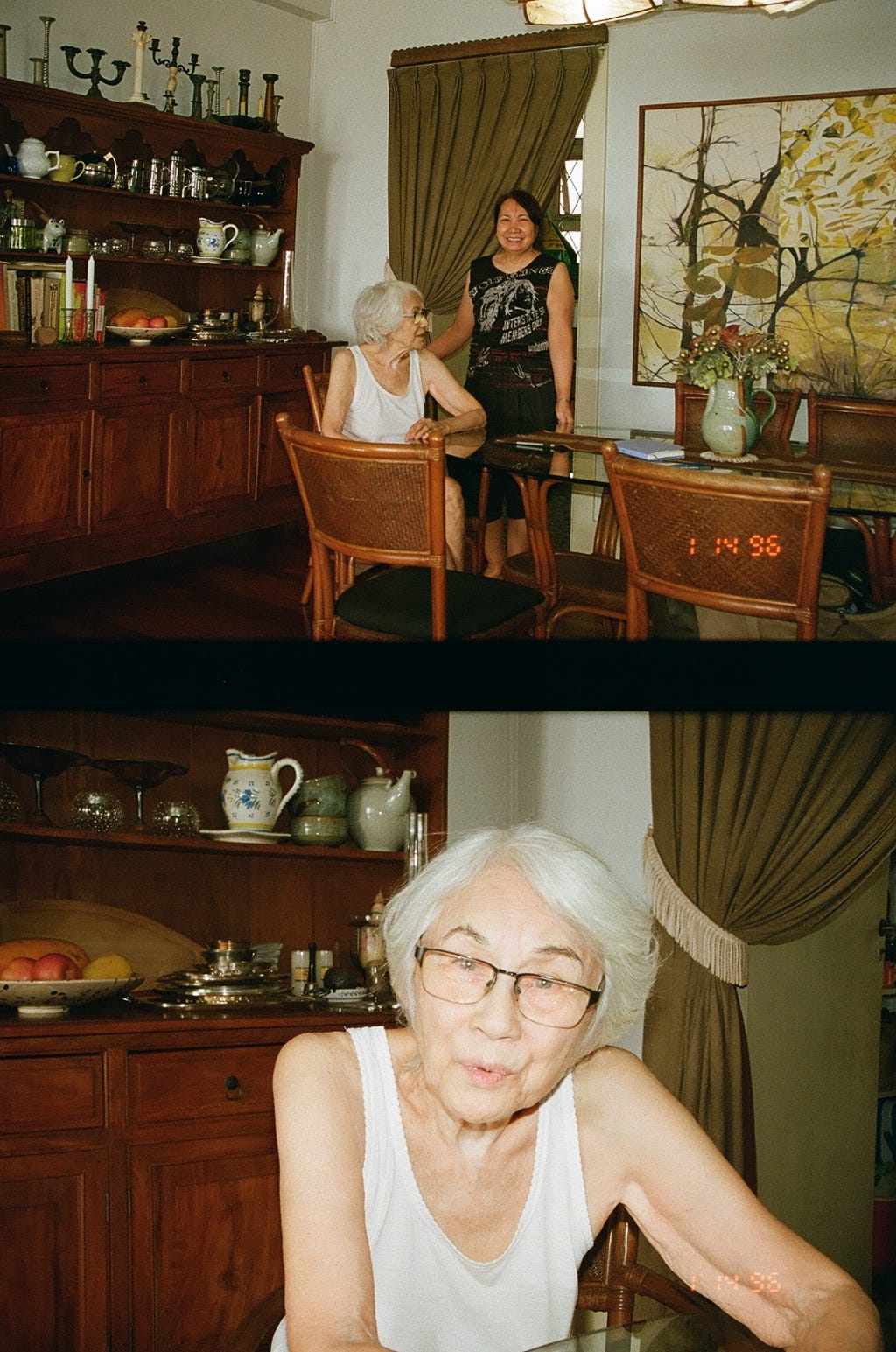
As her goddaughter—and because my mom asked me to—I’ve taken on a caregiving role, although one without the day-in day-out demands that Clarita and Beth shoulder. On this trip I saw Dolores’ neurologist to learn how her dementia is progressing (it’s stabilized). I met with a lawyer to draft a Living Will that functions in the Philippines, where Catholic mores make conversations around death complicated. I helped her renew her passport. And I visited her bank to learn how to ensure Clarita can access her account if Dolores forgets her signature or becomes bedridden. Clarita already pays the rent, utilities, food costs, and her and Beth’s salaries, but to access the funds she must visit the bank in person with Dolores each month and make a withdrawal.
My larger family in the Philippines was horrified to learn I planned to give Clarita direct access to Dolores’ account. If her family finds out, they’ll pressure her into stealing money, they assured me, worming distrust. But I explained that my aunt has a small monthly social security deposit so there are no riches to steal; that Clarita has worked for Dolores for decades, including caregiving for my grandfather and Larry while they died; that Clarita already manages the money; and that in all honesty I’d be glad if she found extra to pocket.
Everyone took the last item as a joke, but I wasn’t kidding, and I didn’t tell them the other thought coursing through my mind: that I trusted Clarita more than anyone else. To swindle or be swindled? Those aren’t always the only options.
Sheltered by my middle class U.S. upbringing, I don’t know how to navigate the class divide in the Philippines, which I find upsetting for both sides. The heart-wrench of poverty confronts me during every walk I take near my aunt’s apartment, but from my first trip there as an 11-year-old, I also felt that being wealthy was a nightmare. I understand the obvious, palpable benefits of excessive money, but I don’t think we talk about the downsides often enough. Here’s one example: Some of my family live in gated communities. They enter their neighborhood or buildings past armed guards just to feel relaxed and leisurely. There’s an oxymoron built into this arrangement: to feel safe, they increase the weapons around them. It reminds me of the ironic use of the word “security,” as though having hired guards were not an invitation to danger. I’d argue that security is not having to employ Security. Having less can bring more freedom.
When I was a teen, I remember worrying that the extreme wealth gap I witnessed in the Philippines would become the norm in the U.S., and that I didn’t want to be on either side of it.
It is increasing. And I don’t.
But who am I to preach class consciousness as someone from a country that colonized the Philippines for almost fifty years and continues its neocolonialism to this day? As someone who can afford to travel across oceans? More than once, I’ve made everyone uncomfortable. Overtime, I’m learning something, and it’s not exactly my place, because I don’t believe one should accept proscribed roles, but it is about being devious and respectful at the same time, about seeing everyone as dignified humans and slipping my money to the workers around me when I can. As my mom likes to say, “Whatever you think you’re supposed to be doing, forget it. You’re supposed to be stirring up mischief.”
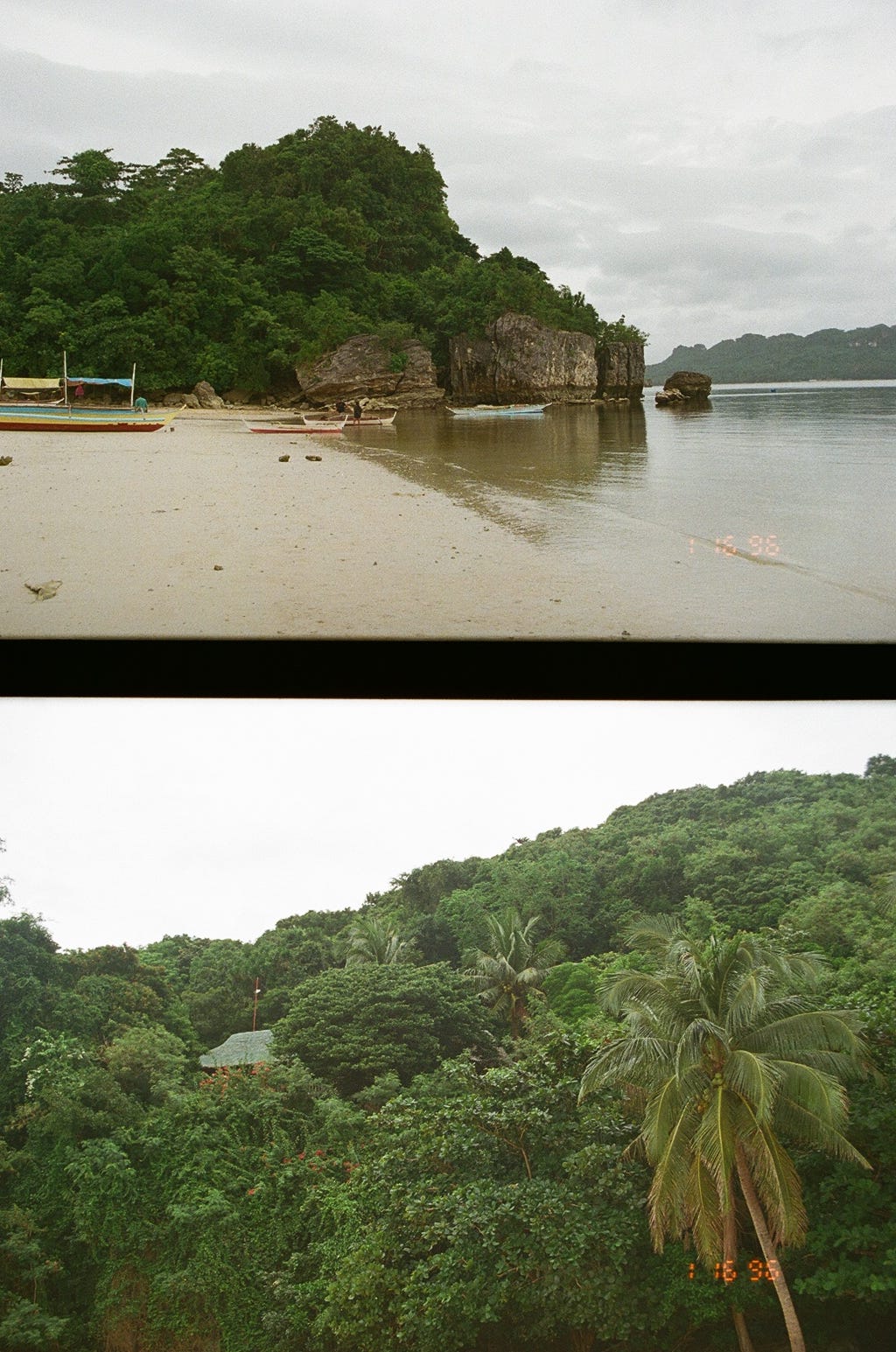
I was in the Philippines for eight jam-packed days. Squeezed between time spent with my aunt, I snuck away to beautiful oceanside land that the larger Marquez family owns.
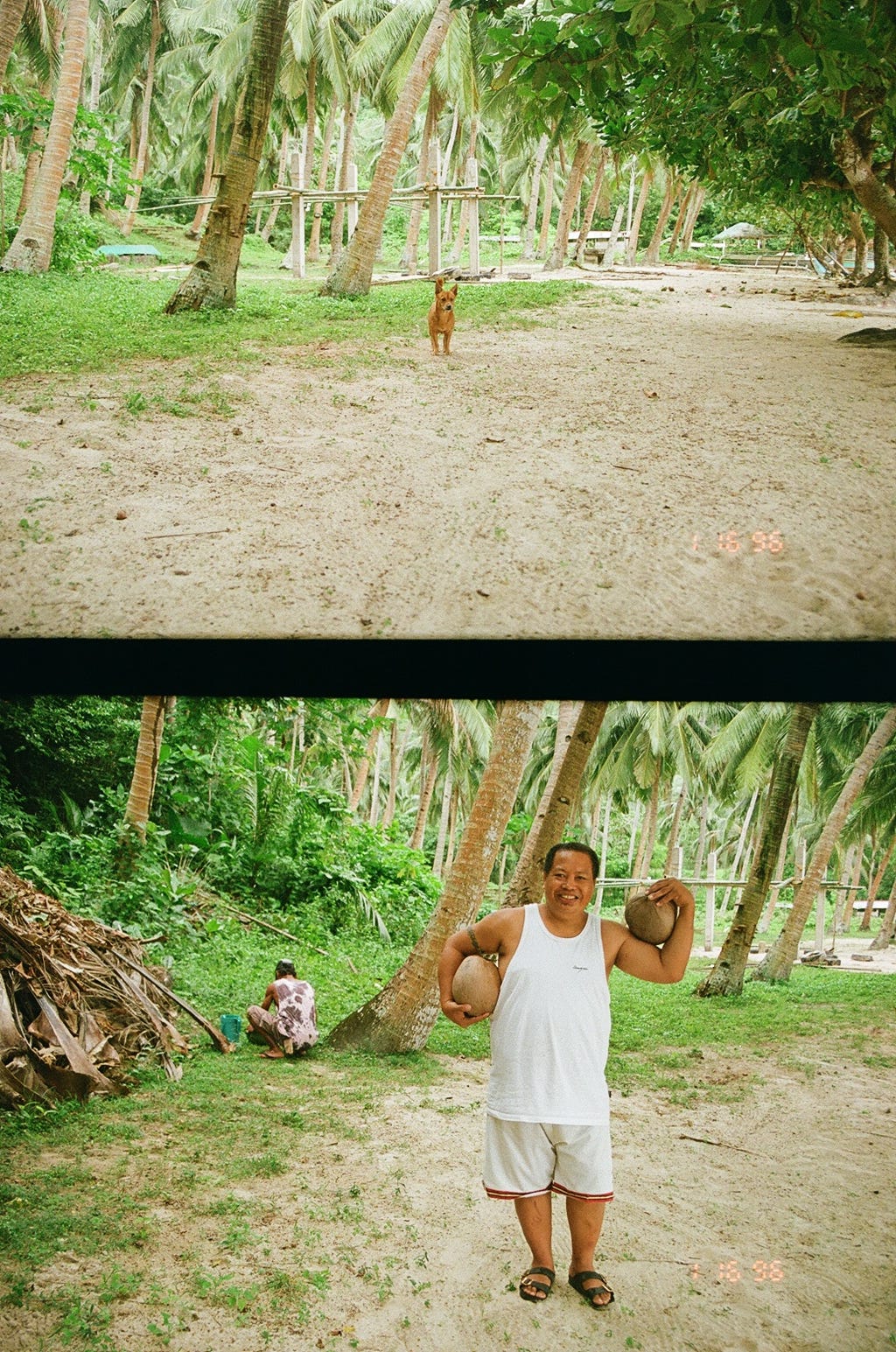
Sometimes I forget to say the most obvious thing of all: I love to eat in the Philippines. In Quezon City, I visited my mom’s cousin and we snacked on the most delicious merienda of fried plantains served with butter and sugar. On Pulo, another of her cousins served Binakol na Manok—a clean chicken soup simmered in coconut water with moringa, lemongrass, ginger, green papaya, young coconut meat, and fish sauce. In Malate, late at night, I snacked on sisig—various bits of sizzling pork drenched in calamansi.
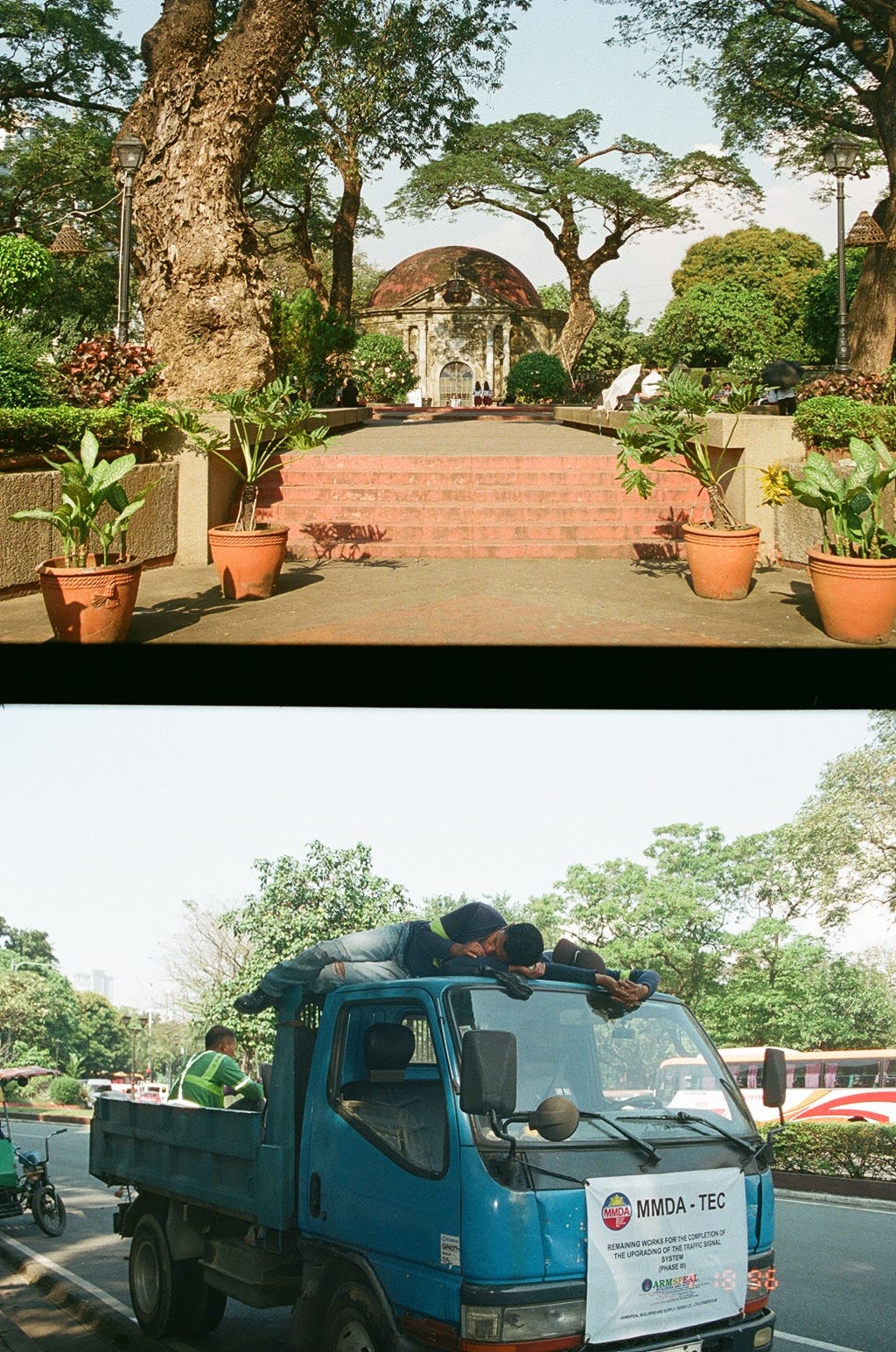
I spent my last full day in Manila exploring on my own. I like to visit the old city, Intromuros, which is a long walk from my aunt’s. Its cobblestone streets and stately buildings speak to other histories laid under our steps. There’s a funny restaurant there called Ristorante delle Mitre that’s intentionally holy and blasphemous, where every menu is named for a Bishop, as though it were his favorite. I imagine these robed men beside me, fat glistening on their beards, groaning over a plate of Bikol Express. I could go somewhere else, but I’m obsessed with their laing—long simmered taro leaves in coconut milk with dried fish, shrimp paste, and ginger, topped in crunchy pili pili nuts. Archbishop Gilbert Garcera’s favorite, or so they say. It’s dank in the most primordial way, and as long as they make it, I’ll always return.
From there, I walked northeast to Paco Park and Paco Market, bought a San Miguel pilsner at a corner market, and cooled off at a friend’s, enjoying visits from the neighborhood cats.
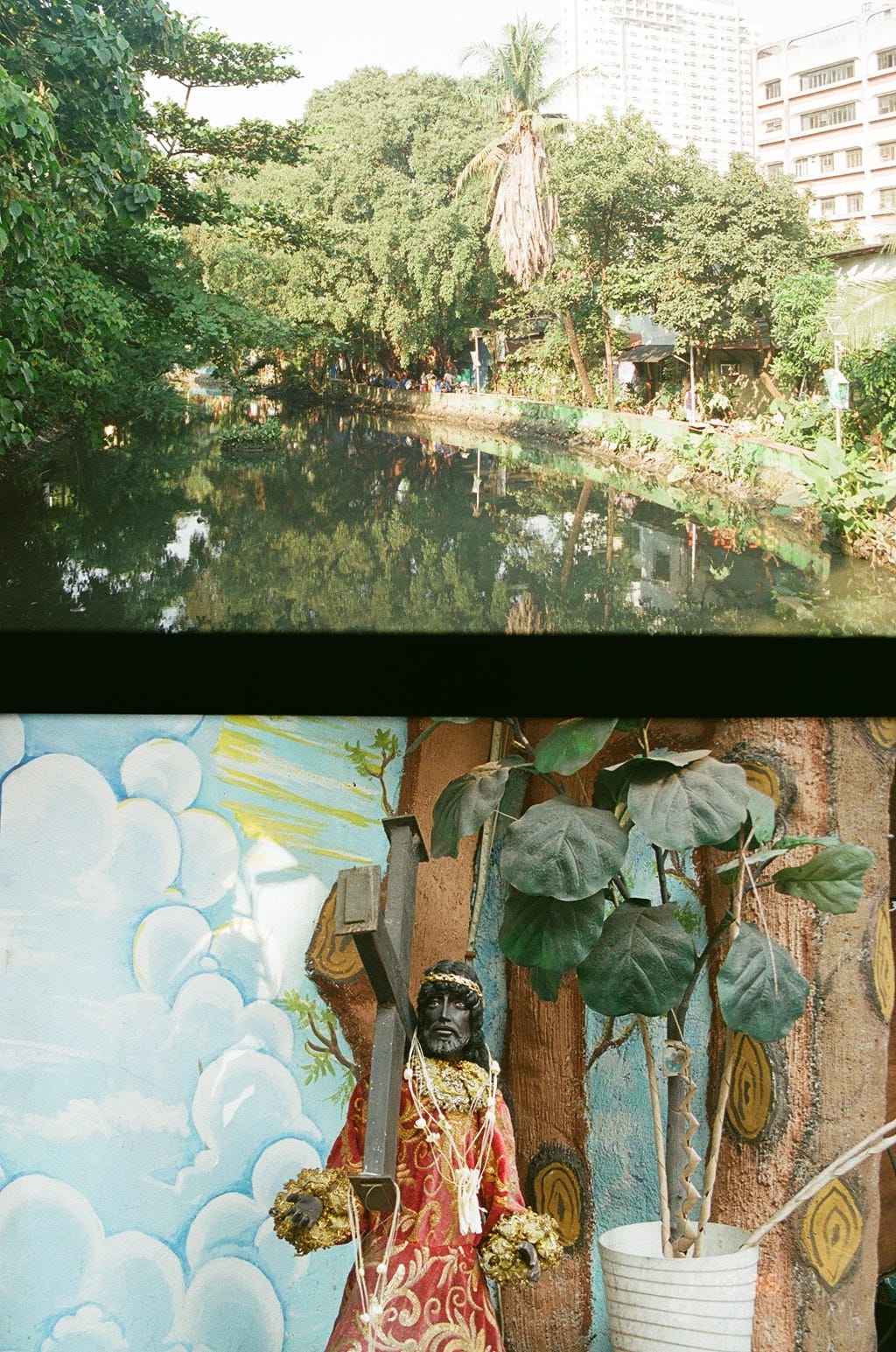
On this trip I didn’t visit the Quiapo Church, but I did see this replica of the evocative Black Nazarene, a statue with a cultish following that’s housed there, which was made in Mexico in the 1600s.
When I come to the Philippines, I feel a weight of responsibility towards my aunt and family. I feel naive and ungainly in my behavior, stripped of my sheltered life and confronted with realities larger than my own. I also feel extremely curious and awed. I see the inheritances my mom passed to me: my love of acidity, garlic, pork, the gummy chewy texture of glutinous rice, the crackle of a fried lumpia wrapper, basketball, small gifts, nicknames! I hear my own big laugh in the cackles of my mom’s cousins. I feel deeply foreign, and I feel confusingly, irrevocably, connected.
From the Philippines, I flew to Japan to cool off. I’ll write about that soon!

Thanks for making it this far. I have one more order of business!
Sunday, March 15: Cookbooks and Clay
My wonderful friend Jamie Holub of Sandy River Studios is hosting me in mid-March for a sweet collaboration.
I’ll be sharing from my book, Group Living and Other Recipes (you’ll get a copy!);
she’ll lead us in making our own ceramic rice bowls, which she’ll glaze and ship to each person;
I’ll demo how to make perfect miso soup and onigiri (rice balls), using vegetables from the surrounding Flying Coyote Farm fields;
we’ll all try our hand at it;
and then we’ll feast together!
If this sounds like a lovely Sunday afternoon, please join us!
Ooh this took me on a journey. 💜
i loved this one <333
the cabs and the Grabs </3
false-ifying the dichotomy of swindler and swindlee <3